

How ISM students and international participants built functional apps using AI – and what it means for the future of entrepreneurship education.
Last week, ISM University of Management and Economics became the home of something unprecedented in Lithuania: the country’s largest in-person vibecoding hackathon.
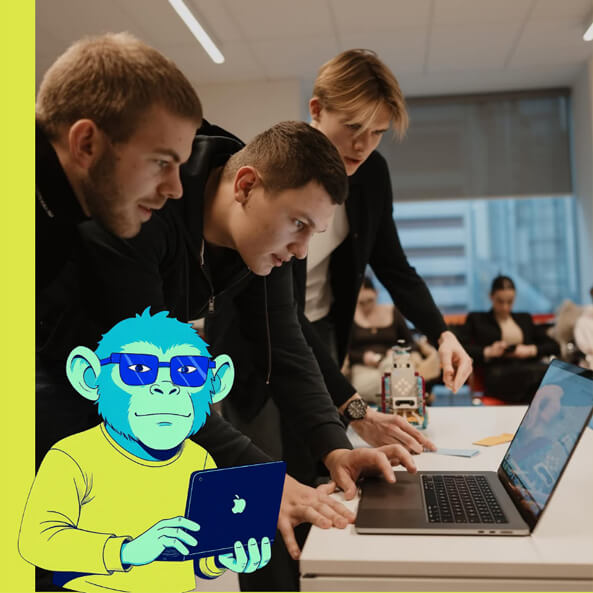
Over five days, 170 students from 12 universities across Lithuania, Germany, Latvia, Belgium, and India gathered in Vilnius to build functional applications – without writing a single line of traditional code.
What is vibecoding?
Vibecoding is a new approach to software development where humans describe what they want to create in natural language, and AI tools generate the working code. No programming languages required. No years of technical training. Just a clear idea and the willingness to experiment.
“For me, vibecoding is like having a coding partner who knows every language,” explains Aarti Seth, the hackathon’s first-place winner from India’s Birla Institute of Technology. “I can focus on what I want to build, and AI fills in the gaps.”
This approach is gaining momentum globally – and ISM decided to bring it to Lithuanian students.
Why this matters for entrepreneurship education
Traditional hackathons often favour participants with technical backgrounds. Vibecoding changes that equation entirely.
Among our hackathon participants were business administration students, marketers, physiotherapists, sports scientists, and designers. Many had never imagined they could build technology products. By the end of the week, they had working prototypes.
“Students grasp AI logic incredibly quickly and start using these tools as equal partners in the creative process,” says Vaida Bitvinskė, ISM PhD researcher in Human-AI Interaction and the hackathon’s initiator. “This allows them to test ideas in real-time and see immediately how they work in practice.”
This aligns with ISM’s core belief: entrepreneurship is learned by doing, not just by planning.
The winning projects
Testing ideas before they become failures
First Place: FocusAI – Taran Murugan Rekha (ISM) & Aarti Seth (Birla Institute of Technology, India)
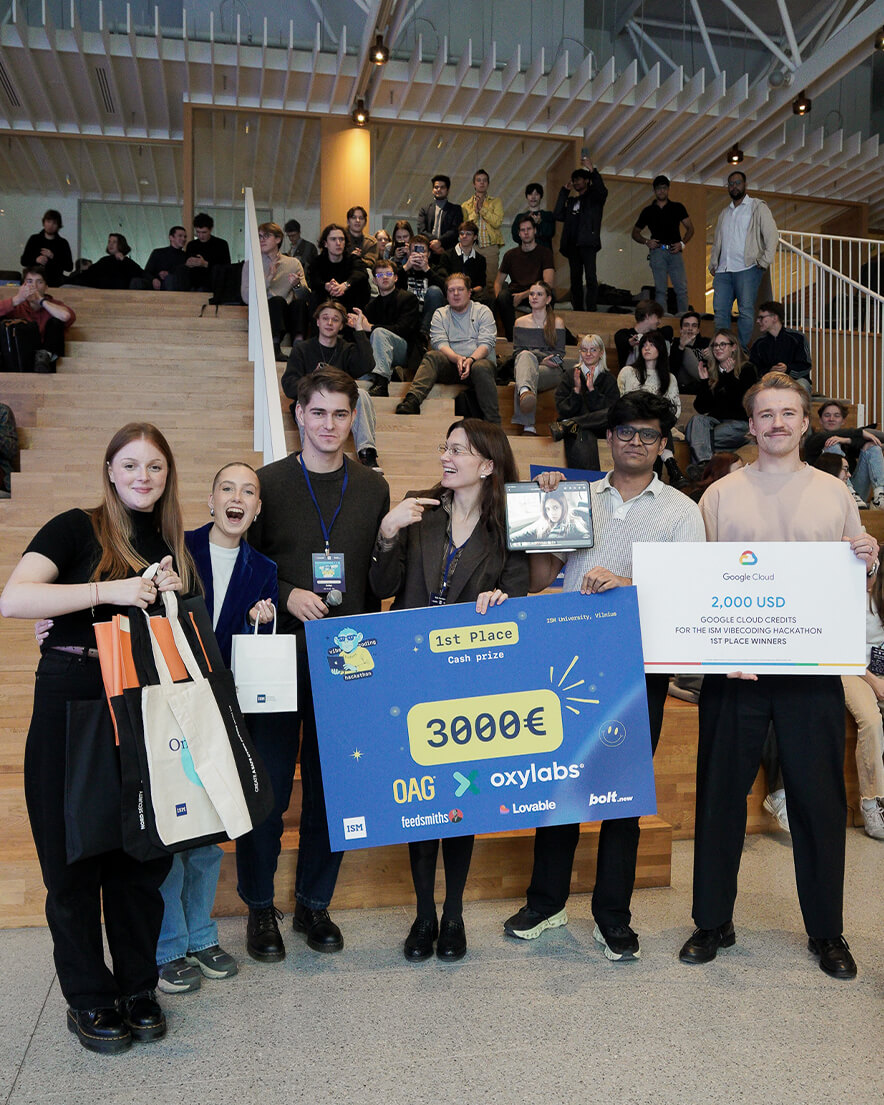
“Founders often spend weeks building something, only to discover nobody wants it,” explains the FocusAI team. Their solution? A virtual focus group tool that lets entrepreneurs test product ideas with AI-powered “users” – different personalities who don’t just answer questions, but debate each other, simulating real consumer dynamics.
The project’s development story is as impressive as the tool itself. Aarti joined the team midway through the hackathon and built the entire technical infrastructure in just a day and a half, submitting their project two minutes before the deadline.
“I have vibecoded before,” says Taran, “and coming to the hackathon did not have very high expectations. But I was very impressed by the vast list of sponsors and did not expect the vibes and the competition to be this high – especially in a business school.”
For Aarti, the experience demonstrated vibecoding’s power: “Instead of spending hours stuck on syntax or documentation, I could focus on what I wanted to create, and AI filled in the gaps. That was decisive – especially building the entire backend in a day and a half.”
Both team members left with renewed confidence. “It made me more confident in rapidly prototyping and launching ideas into the real world more quickly,” Taran reflects. “My experience has been amazing, especially with the support at the hackathon and the carousel of mentors that were available to us.”
Taran now recommends vibecoding widely: “To everyone, to be honest – the rest of my coursemates who did not participate in the hackathon and everyone out there who has an idea but isn’t acting on it.”
When your dog’s collar knows something you don’t
Second Place: Tailysis – Danielius Gelumbauskas, Rugilė Noreikaitė & Aleksas Petravičius (ISM)
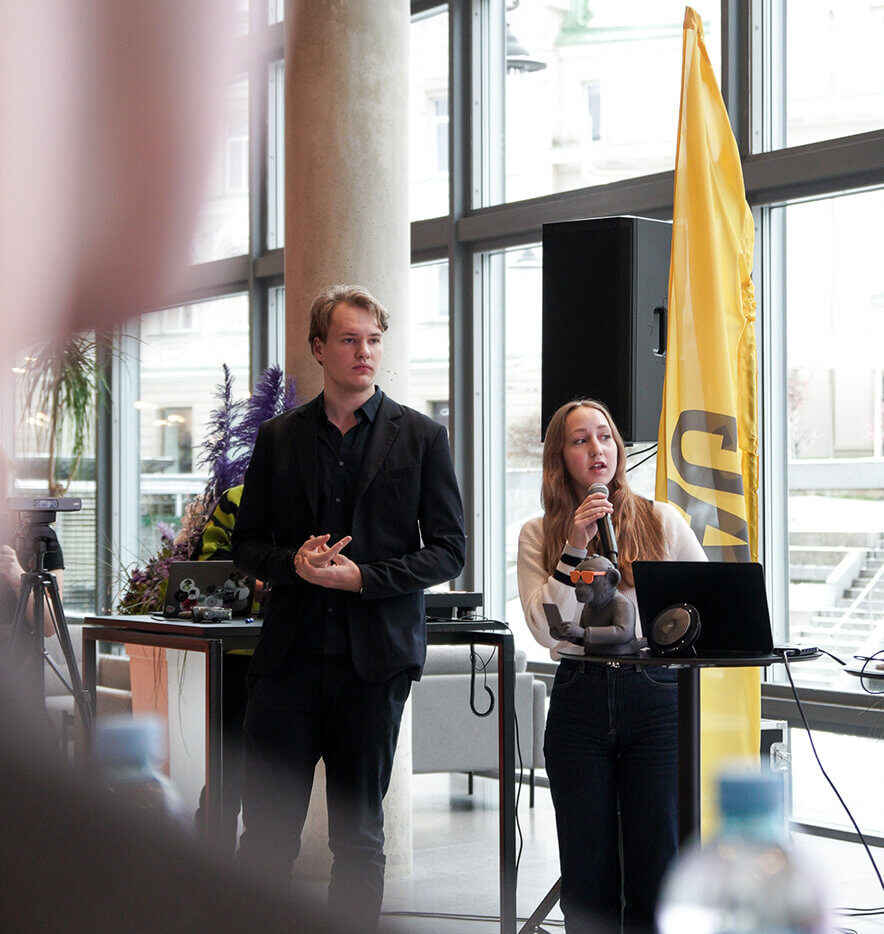
Dogs show internal stress and health signals long before humans can see visible symptoms. By the time owners notice something is wrong, it’s often too late for early intervention. Tailysis addresses this gap with a biometric collar that monitors heart rate, temperature, and movement – translating raw data into understandable signals about a pet’s emotional and physical state.
“Dogs show internal stress signals much earlier than humans can see them,” the team notes. “We wanted to give pet owners a chance to act early.”
For team member Aleksas, the hackathon provided something invaluable: “An environment to test ideas, learn new tools, and see how far a small team can push an MVP under pressure.”
The experience significantly shaped his entrepreneurial outlook. “It boosted it a lot,” Aleksas says. “Building something real in such a short time showed me how quickly ideas can become prototypes, and it motivated me to take on more ambitious projects.”
His overall assessment? “Intense, productive, and actually fun. I learned new tools, built a working prototype, and met people who think the same way. It was worth it.”
Would he recommend vibecoding to others? “Yes. I’d recommend it to students who want hands-on experience, early-stage founders validating ideas, and anyone who wants to grow fast through real teamwork and deadlines.”
Automating physiotherapy without replacing physiotherapists
Third Place: KineziAI – Daumantė Petraitytė (Lithuanian Sports University) & Margarita Sivačiova (ISM)
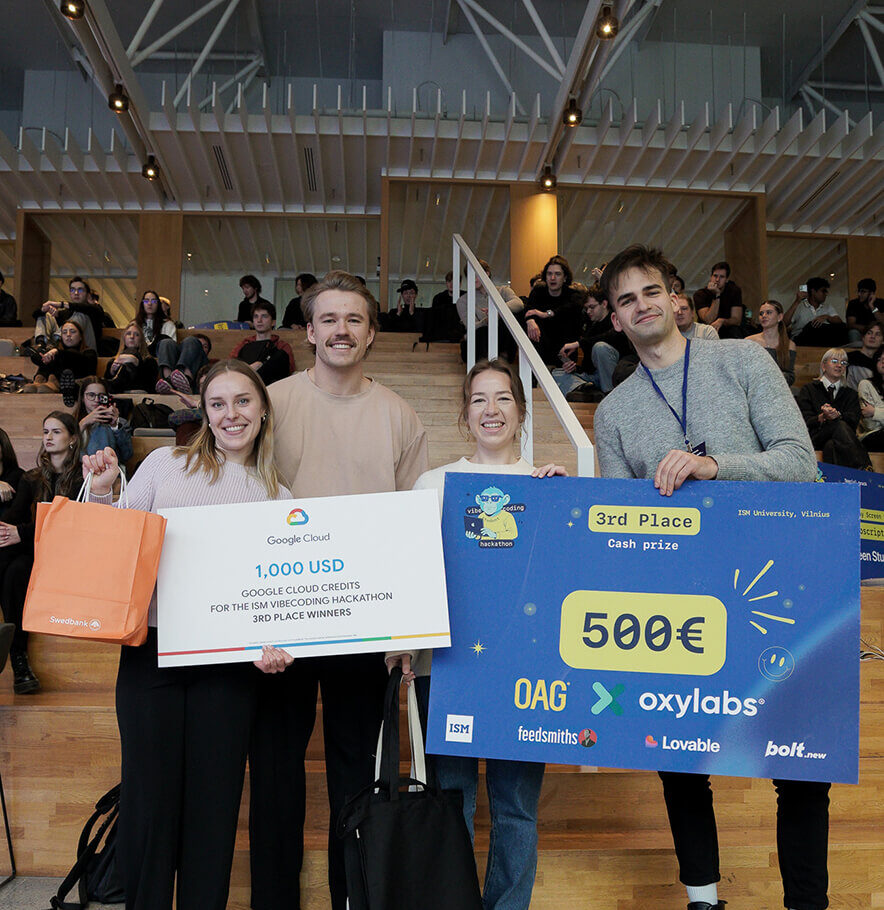
Both team members are practicing physiotherapists who saw the same problem daily: specialists overloaded with work, patients waiting months for appointments, and therapists spending hours on routine exercise program design that could be automated.
KineziAI analyzes video recordings of patient movements and automatically generates personalized exercise programs – but critically, it keeps the specialist in control. “We wanted to automate the routine work while keeping professionals in control,” the team explains.
Coming into the hackathon, neither had vibecoded before. “What encouraged us to join was the fact that no prior experience was required, so we felt comfortable taking the leap,” Daumantė recalls. “We didn’t come with high expectations – we were simply excited to create and explore something new.”
Their third-place finish exceeded their expectations: “Winning third place – especially when we thought it was unlikely – gave us a huge boost of confidence. But even more inspiring was the community itself. Being surrounded by so many passionate and driven people motivated us even more than the win.”
The experience proved challenging but worthwhile. “Everything was new to us, we learned a lot, and we tried many different things,” says Daumantė. “It was challenging at times, especially while balancing work and our master’s studies, but we left feeling genuinely satisfied and inspired.”
Their recommendation? “Absolutely – we would highly recommend it. Vibecoding is great for anyone who has even a small interest in creating or experimenting with new ideas. You don’t need extensive experience or a perfectly formed concept. Simply being in a creative environment, meeting motivated and talented people, talking to mentors, and hearing their insights provides value that anyone can carry into the future.”
Beyond the podium: Special recognition
The hackathon also awarded special prizes to other standout projects:
Best Voice App (ElevenLabs): Reconnect Generations – a platform that preserves grandparents’ voices and stories as interactive digital memory twins.
Best Design (Whytheduck): Nearbuy – a local inventory search tool built by a mixed Lithuanian-German team from ISM and Hamburg School of Business Administration.
Public Vote + Most Lovable Project: Walky Doggy – an app that encourages walking through virtual pet care.
Best Financial Innovation (StockInvest): Three projects earned this recognition – Flip AI, InvestoLight, and INNVOS.
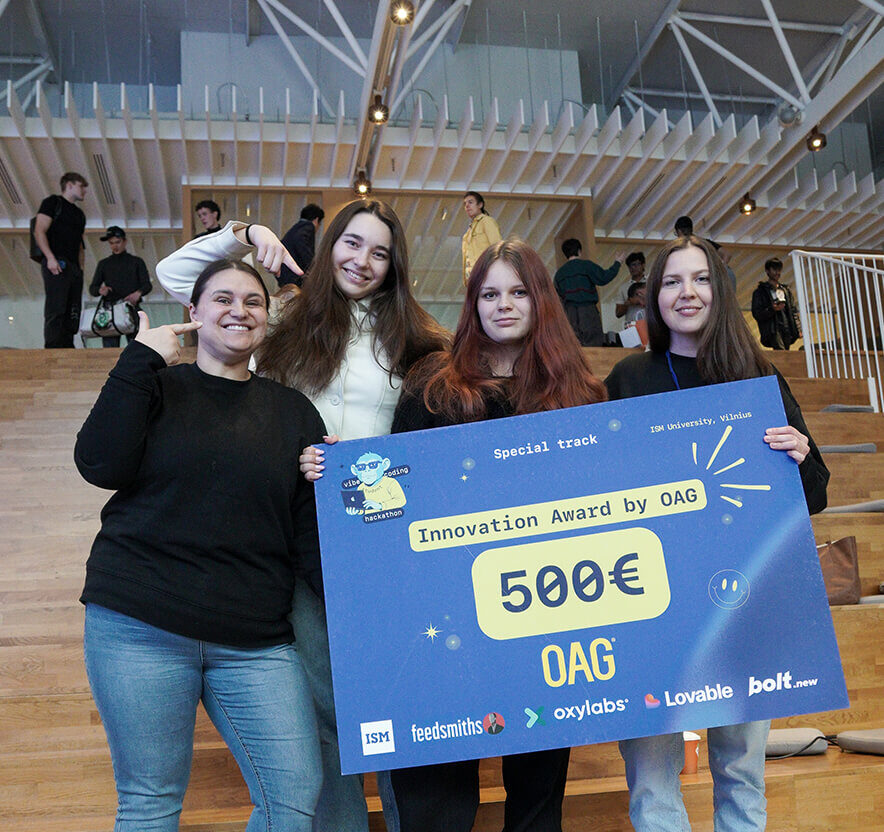
OAG Innovation Award: AERO – an enhanced airports app.
A small team, a big impact
The hackathon was organized by a small but dedicated team: Vaida Bitvinskė, alongside ISM Entrepreneurship and Innovation students Justina Janušonytė and Gabrielė Bieliauskaitė.
Despite limited resources, the event attracted significant attention – including partnerships with leading technology companies from Lithuania and around the world.
“We wanted this event to serve the entire community, not just one university,” says Eigirdas Žemaitis, Director of ISM’s Entrepreneurship and Innovation Program. “Open platforms where students can create, test, and implement their ideas are essential for Lithuania’s innovation culture to grow.”
Thank you to our partners
This hackathon wouldn’t have been possible without the generous support of our sponsors and partners. Main Partners: Lovable, ISM, bolt.new Community Partners: OAG, Oxylabs Supporters: Google Cloud, 4Beta, ElevenLabs, Screen Studio, Supercorp, Rockit, WhyTheDuck, Humble AI, Brite, Firecrawl, AddEvent, Helmes, Robinhood, Haus of Wllnss, Natively, Caffeine, Swedbank, StockInvest.us, ScrapingBee, Gymplius, Firstpick, Nestlé, Rimi, Unicorns Lithuania, Startup Lithuania, The Feedsmiths
Mentors and judges who made it possible
Special thanks to all mentors, judges, and volunteers who dedicated their time and expertise to support our students throughout the hackathon.
Mentors: Donatas Mažeika, Almantas Karpavičius, Roman Lobas, Milda Vilčinskaitė, Jokūbas Vaičiulis, Martynas Cepas, Jonė Vaitulevičiūtė, Mahdi Shariff, Domas Bitvinskas, Kipras Vaičekauskas, Katrė Zienkaitė, Ignas Grigaliūnas, Ugnius Ramanauskas, Tomas Šiurna, Ignas Survila, Cédric Charpenet
Preselection Judges: Tomas Šiurna, Vaida Bitvinskė, Domas Bitvinskas, Eigirdas Žemaitis, Kipras Vaičekauskas
Demo Day Judges: Eigirdas Žemaitis, Kipras Vaičekauskas, Marija Milaševičiūtė, Gabrielius Mažeikis, Ignas Grigaliūnas, Benvenutas Grinius
Your belief in the next generation of entrepreneurs makes events like this possible.
What’s next?
Given the overwhelming interest and growing international participation, organizers are already planning next year’s edition – with even more universities and partners from abroad.
The message from this year’s hackathon is clear: the barrier between having an idea and building it has never been lower. And ISM is committed to giving students the skills, tools, and opportunities to cross that barrier.
The Student Vibecoding Hackathon took place November 24–28, 2025, at ISM University of Management and Economics in Vilnius.
All Winners
1st Place: FocusAI
- Taran Murugan Rekha – ISM
- Aarti Seth – Birla Institute of Technology, Pilani
2nd Place: Tailysis
- Danielius Gelumbauskas – ISM
- Rugilė Noreikaitė – ISM
- Aleksas Petravičius – ISM
3rd Place: KineziAI
- Daumantė Petraitytė – Lithuanian Sports University
- Margarita Sivačiova – ISM
Best Voice App (ElevenLabs): Reconnect Generations
- Rokas Alešiūnas – ISM
- Emilis Zabilius – ISM
- Liutauras Cijunskis – ISM
- Motiejus Bucinskas – ISM
Best Design (WhyTheDuck): Nearbuy
- Jann Brunken – HSBA
- Linus Hagge – HSBA
- Joris Mackevičius – ISM
- Kasparas Sasnauskas – ISM
Public Vote + Best Lovable Project: WALKY DOGGY
- Ravi Joshi – Vilnius Tech
- Julija Osipova – Riga Technical University
- Ratmir Kutuzov – Riga Technical University
- Pranava Kumar Krishna Kumar – Vilnius Tech
Best Financial Innovation (StockInvest): Flip AI
- Maxell Aguiran – ISM
- Irfanulla Khan – ISM
Best Financial Innovation (StockInvest): InvestoLight
- Matas Baranauskas – ISM
- Luka Mizaraitė – ISM
- Andromeda Jonikatė – ISM
- Lėja Petkevičiūtė – ISM
Best Financial Innovation (StockInvest) + Best Demo (Screen Studio): INNVOS
- Tomas Abečiūnas – ISM
- Gabriela Jokimas – ISM
- Aleksandras Inčiūra – ISM
Best AI Wrapper (Supercorp): Planaging
- Damian Gaidukevič – ISM
- Martynas Žemaitis – ISM
- Motiejus Petronis – ISM
OAG Innovation Award: AERO airports app
- Auksė Uršulė Rudzikaitė – ISM
- Ieva Bigailaitė – ISM